

Updated June 11, 2021
So, you got fully vaccinated - congratulations! You’re among the 46% of people in the United States almost entirely protected from hospitalization and death related to COVID-19.
The great news? New CDC guidelines from May 28th, 2021, say that fully vaccinated people can resume most of their pre-pandemic activities without masks or physical distancing. Check out the graphic below for a list of situations that don’t require masks and their level of relative risk.
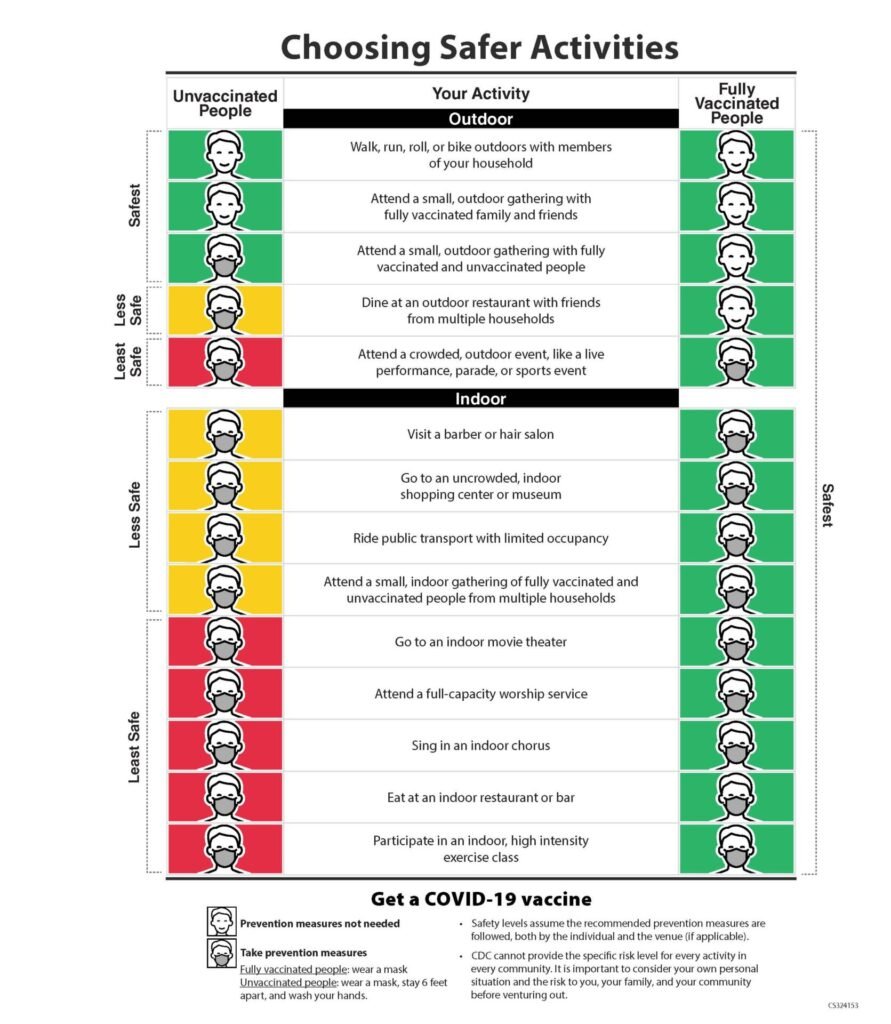
However, even though you’re protected now, you may still have family, friends, neighbors, or colleagues who are not vaccinated. The CDC recommends that vaccinated people continue to wear masks and maintain physical distance on public transportation (e.g., buses, trains, etc.) and when traveling (on airplanes, in airports). It’s not a bad idea to keep wearing masks in crowded indoor settings with people of mixed vaccination status. As a reminder, this is a temporary recommendation until more people are vaccinated and new COVID-19 case rates go even further down.
Not convinced? Here are five reasons why you should keep wearing masks on public transportation, while traveling, and when in crowded indoor settings after being vaccinated:
- Efficacy, or the protection vaccines offer against any COVID-19 infection in clinical trials, is estimated to be 94.1% for the Moderna vaccine, 95% for the Pfizer vaccine, and 66.9% for the Johnson & Johnson vaccine. That said, certain populations not represented in the trials--including pregnant women and those living with cancer--may not be as well protected.
- Immunity. After getting the second dose, it takes 2 to 3 weeks for your body’s immune response to fully develop. Once established, immunity may decline over time. The duration of vaccine immunity against COVID-19 is not certain: it could require an annual shot to protect against multiple strains or a booster after multiple years.
- Transmissibility. Vaccinated people appear less likely to spread the virus. But doctors are still studying just how often this happens. And new variants might be easier to spread.
- Herd immunity is the percent of the population either infected or inoculated that is needed to control a pandemic. Experts estimate at least 70% of the population would need to be vaccinated against COVID-19. In the U.S. that would be over 200 million people. Until more people are vaccinated, the virus will continue to spread.
- Modelling safe practices is a good way to establish new social norms. Continuing to wear a mask and maintaining 6 feet of distance when recommended makes it easier for unvaccinated people to do the same.
What’s the bottom line?
We need more people to get vaccinated and doctors want to learn more about how the vaccine works in real world settings before we can entirely lift measures that prevent COVID-19 from spreading in the community.
Last update: June 11, 2021, 12:30 EST
Science review: SKB, GSN